
Aerothermal with Underfloor Heating and Cooling in Madrid: The Complete Guide
Cooling underfloor combined with aerothermal provides heating in winter and cooling in summer through the same circuit. Requirements, condensation, controls and indicative pricing for Madrid homes.
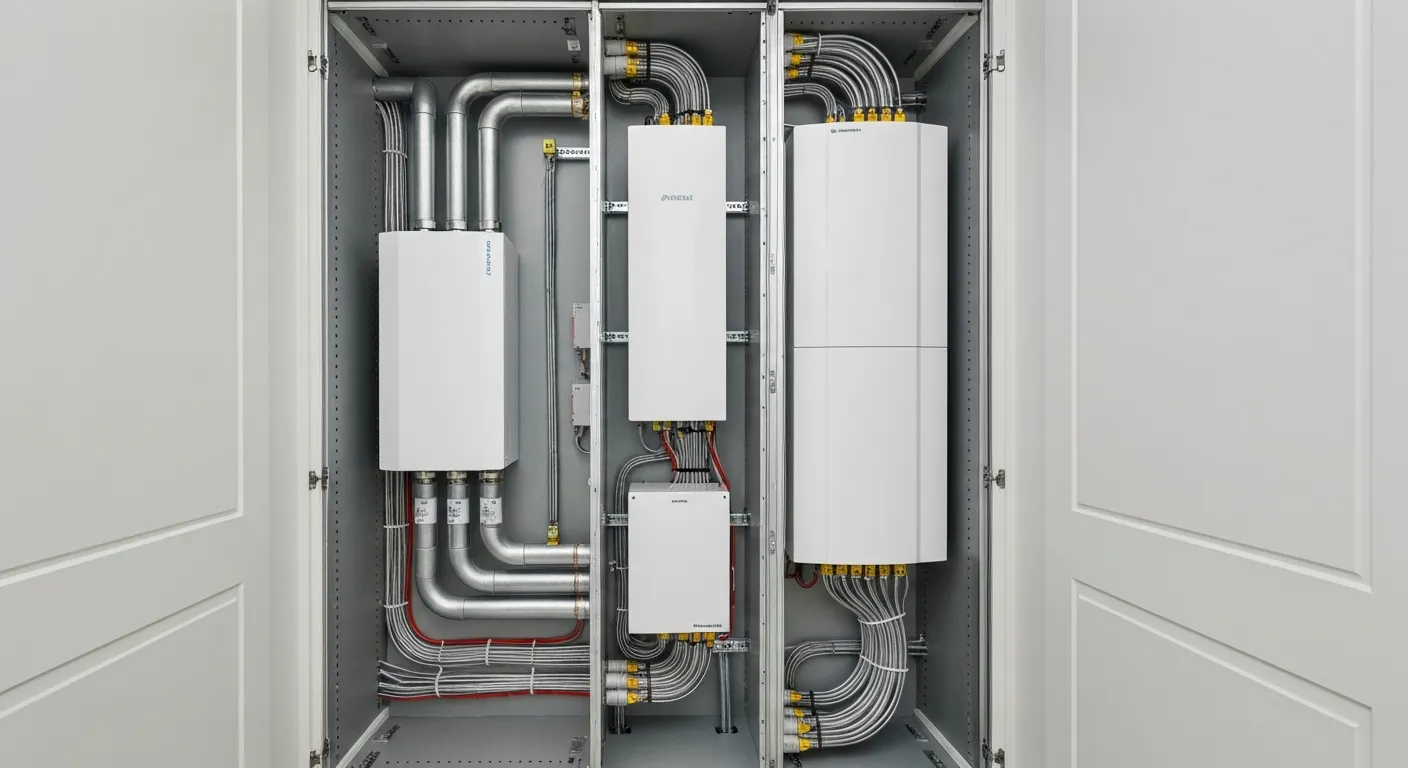
Cooling underfloor heating is the most comfortable and efficient solution for climate control in a Madrid home. With a single circuit of pipes embedded under the floor, aerothermal can heat your home in winter and cool it in summer — silently, evenly and with minimal electricity consumption. But not every home qualifies. This guide explains when it's viable, what technical requirements it needs and how much it costs.
What is cooling underfloor heating?
Traditional underfloor heating circulates hot water (35-45°C) through cross-linked polyethylene (PERT or PEX) pipes installed beneath the floor. Cooling underfloor uses the same circuit, but in summer it circulates cold water (18-20°C) that absorbs heat from the room from the floor upward, via thermal radiation rather than convection. The result is silent, uniform cooling without the discomfort of traditional air conditioning.
Advantages of underfloor heating with aerothermal
- One system, two functions: heating in winter and cooling in summer with the same circuit and the same aerothermal heat pump.
- Maximum comfort: air temperature is uniform from floor to ceiling, with no stratification or draughts.
- Absolute silence: no indoor units with fans. Only the floor emits cooling or heating.
- Maximum efficiency: aerothermal working at 35°C for heating and 18°C for cooling operates in its highest COP and EER range.
- Aesthetics: no visible splits, cassettes or ducts. Ideal for premium properties and full renovations.
The condensation problem: the critical point
The greatest risk of cooling underfloor is surface condensation. When the floor temperature drops below the dew point of the room air, condensation forms (the floor "sweats"). In Madrid, where summers are dry but nights can be humid, this risk is real.
To prevent it, the system must include:
- Dew point temperature sensor: measures air humidity and temperature and automatically adjusts the cold water temperature to not drop below the dew point.
- Climate control: regulates the flow water temperature based on ambient conditions, not just the setpoint.
- Dehumidification systems: in homes with high humidity, a complementary air dehumidification system may be necessary.
Without these controls, cooling underfloor can cause condensation damage: moisture on the floor, parquet deterioration, mould on skirting boards. That's why installation by a qualified technical team is essential.
Which Madrid homes qualify?
| Home type | Cooling underfloor viability | Notes |
|---|---|---|
| Detached/semi-detached villa (new build or full renovation) | High | Ideal. Circuit designed from scratch with proper insulation. |
| Penthouse with full renovation | High | Viable if flooring and slab insulation are renewed. |
| Flat with floor renovation | Medium | Possible if existing flooring is lifted. Check ceiling height. |
| Flat without floor renovation | Not viable | Cannot install without lifting flooring. Better: fancoils or splits. |
| Listed building | Not viable | Heritage restrictions prevent modifying original flooring. |
For partial renovations where the floor cannot be lifted, the alternative is combining aerothermal with low-temperature radiators for heating and splits or fancoils for cooling.
Technical requirements for cooling underfloor
- Slab insulation: underfloor must be installed over a thermal insulation layer (extruded or expanded polystyrene) so cooling or heating isn't lost to the floor below.
- Floor thickness: the system adds 5-8 cm of thickness (insulation + pipes + levelling screed + flooring). Door clearance must be checked.
- Flooring type: ceramic, porcelain and stoneware tiles are ideal (high conductivity). Parquet or natural wood is possible but requires perimeter expansion joints and extra care. Carpet is not compatible.
- Zoned circuits: each room must have its own circuit with manifold and independent control, so cooling is zoned.
- Compatible aerothermal heat pump: must be a model that supports cooling with low flow temperature (18-20°C). Not all aerothermal units on the market allow this.
Indicative pricing in Madrid
| Element | Indicative price | Notes |
|---|---|---|
| Cooling underfloor (materials + installation) | €60-90/m² | Includes insulation, pipes, manifolds and screed. Excludes flooring. |
| Aerothermal heat pump (8-12 kW) | €6,500-11,000 | Inverter unit, compatible with low-temperature cooling. |
| Dew point control system | €800-1,500 | Mandatory for cooling. Includes sensors, controller and actuators. |
| Full project (200 m² villa) | €22,000-35,000 | Underfloor + aerothermal + control + DHW. VAT excluded. |
Prices are indicative and depend on the selected brand, installation complexity, slab condition and number of zones. For more context on aerothermal investment, see our guide on aerothermal in flats vs villas in Madrid.
Want cooling underfloor heating in your Madrid home?
We perform a complete technical study: verify floor viability, calculate heat loads, select the right heat pump and design the anti-condensation control system. No-obligation site visit.
WhatsApp: Underfloor cooling + aerothermal studyFrequently Asked Questions
Does cooling underfloor cool as much as air conditioning?
Not the same way, but more comfortably. Cooling underfloor doesn't drop the temperature as quickly as a split, but maintains a superior comfort sensation by eliminating thermal radiation from the floor. In peak Madrid summer (38-40°C), cooling underfloor can maintain the home at 24-26°C, but it's not sufficient for a home with large west-facing windows and no solar protection.
Can cooling underfloor be installed in an already renovated flat?
Only if the existing flooring is lifted and the system is installed from the slab. If you don't want to renovate the floor, the alternative is aerothermal with fancoils (which also cool) or wall splits.
What happens if the power goes out in summer?
The floor has high thermal inertia: it takes hours to heat up or cool down, but also hours to lose its temperature. If the power goes out, the floor maintains cooling for several hours. This is an advantage over splits, which stop cooling immediately.
Does underfloor cooling create humidity?
Only if there's no dew point control. With a properly installed dew point sensor, the system automatically adjusts the water temperature to prevent condensation. It's mandatory in every cooling underfloor installation.
Can I combine cooling underfloor with solar panels?
Yes, and it's an excellent combination. Aerothermal consumes electricity and solar panels generate it. In summer, when you need the most cooling, you have the most solar production. See our guide on aerothermal and solar panels in Madrid (coming soon).
What maintenance does cooling underfloor need?
Annual maintenance of the aerothermal heat pump (filter cleaning, refrigerant check, outdoor heat exchanger cleaning) and hydraulic circuit pressure check. The underfloor circuit itself needs no specific maintenance. See our HVAC maintenance service in Madrid.
Related Articles
Aerothermal in a Flat vs. a Chalet in Madrid: Which Suits You?
Aerothermal works in both flats and chalets in Madrid, but the technical solutions, space needed and investment differ significantly. Guide with real cases, indicative prices and installation requirements.
Does Aerothermal Work with Existing Radiators in Madrid?
Aerothermal can connect to existing aluminium or cast-iron radiators in Madrid homes, but key technical requirements apply: flow temperature, emission surface and unit sizing. Practical guide.
Aerothermal and Solar Panels in Madrid: Integration, Savings and Limitations
Combining aerothermal with solar self-consumption maximizes savings on heating, DHW and cooling. How to size the system, which compensation schemes apply in Madrid and the real limitations.