
Aerothermal in a Flat vs. a Chalet in Madrid: Which Suits You?
Aerothermal works in both flats and chalets in Madrid, but the technical solutions, space needed and investment differ significantly. Guide with real cases, indicative prices and installation requirements.
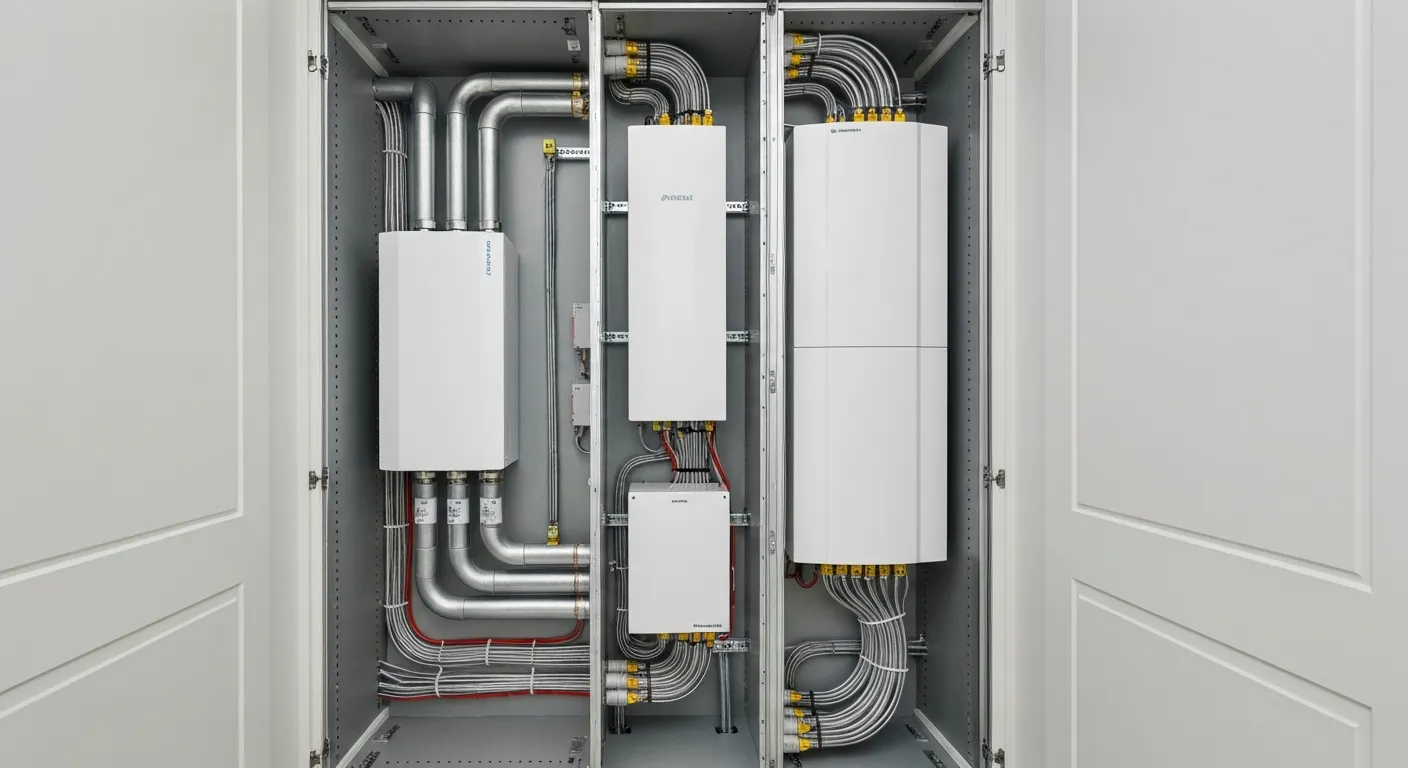
Aerothermal is one of the most efficient climate technologies available in Spain today. It works in any type of dwelling, but installing aerothermal in an 80 m² flat in Chamberí is not the same as in a 300 m² chalet in La Moraleja. The technical solutions, space needed, investment and paperwork differ. This guide compares both scenarios to help you decide.
What Is Aerothermal and Why Does It Work in Madrid?
Aerothermal is an air-source heat pump that extracts thermal energy from outdoor air. Even at -7°C, the air contains usable energy. Madrid has cold winters (lows of -2°C to -5°C in the centre, -8°C in the mountains) and hot summers (highs of 38-40°C), making it an ideal technology: it covers heating in winter, cooling in summer and domestic hot water (DHW) year-round with much lower electricity consumption than gas boilers or electric resistance systems.
The coefficient of performance (COP) of a modern aerothermal unit is between 3.5 and 5.0, meaning that for every kWh of electricity consumed it produces between 3.5 and 5.0 kWh of thermal energy. For more context on efficiency, see our guide on aerothermal with existing radiators in Madrid.
Aerothermal in a Madrid Flat
Space and Equipment Location
In a flat, the main challenge is space. An aerothermal system needs:
- Outdoor unit: placed in the interior courtyard, rooftop (if the community allows) or on a technical balcony. It occupies approximately 1 m² and weighs between 80 and 120 kg.
- Indoor unit (hydrobox): contains the heat pump, heat exchanger and circulation pump. Installed in a technical cupboard, storage room or under the false ceiling. Takes about 0.4 m².
- DHW tank: needed if there's no instant production. A 150-200 litre tank takes about 0.5 m² and 1.6 m of height.
In small flats (under 90 m²) without a storage room or technical cupboard, aerothermal may not be viable. In flats with pre-installation (increasingly common in new Madrid developments) installation is much simpler.
Emission System
In a flat, emission options are:
- Underfloor heating: the most efficient option, but requires construction work (lifting the floor). Only viable during a full renovation.
- Low-temperature radiators: if aluminium radiators already exist, they can be reused if the emission surface is sufficient. Cast-iron radiators are generally compatible.
- Fancoils: allow cooling in summer and heating in winter. The most versatile option for flats without underfloor heating.
Indicative Investment in a Flat
| Component | Indicative price |
|---|---|
| Aerothermal unit (6-8 kW) | €4,000-6,500 |
| DHW tank 150 L | €600-1,000 |
| Fancoils (3-4 units) | €1,800-3,200 |
| Installation and materials | €2,500-4,000 |
| Indicative total | €8,900-14,700 |
Aerothermal in a Madrid Chalet
Space and Equipment Location
In a chalet, space is rarely an issue. The outdoor unit is placed in the garden, patio or rooftop. The hydrobox and DHW tank go in a technical room, garage or basement. In chalets over 200 m², a 250-300 litre DHW tank is recommended.
Emission System
In a chalet, underfloor heating is the preferred option for maximum efficiency and comfort. If the chalet is under construction or full renovation, installing underfloor heating is straightforward. If radiators already exist, they can be reused if compatible with low temperatures. You can also combine underfloor heating on the main floor with radiators in bedrooms.
Indicative Investment in a Chalet
| Component | Indicative price |
|---|---|
| Aerothermal unit (12-16 kW) | €6,500-10,000 |
| DHW tank 300 L | €1,000-1,800 |
| Underfloor heating (200 m²) | €8,000-14,000 |
| Installation and materials | €4,000-7,000 |
| Indicative total | €19,500-32,800 |
Comparison Table: Flat vs. Chalet
| Criterion | Flat in Madrid | Chalet in Madrid |
|---|---|---|
| Required capacity | 6-8 kW | 12-16 kW |
| Outdoor unit location | Interior courtyard or rooftop | Garden, patio or rooftop |
| Typical emission system | Fancoils or existing radiators | Underfloor heating |
| Community permission | Mandatory | No (unless estate rules) |
| Indicative total investment | €9,000-15,000 | €20,000-33,000 |
| Estimated annual savings vs. gas | €400-700 | €1,200-2,000 |
| Return on investment | 10-14 years | 10-16 years |
Estimated savings depend on insulation, consumption habits and electricity tariffs. These figures are indicative and do not constitute a savings guarantee.
Permits and Paperwork in Madrid
In a flat: you need the community of owners' permission to install the outdoor unit on the courtyard or rooftop. If the flat is in a protected building, see our guide on air conditioning in protected buildings in Madrid.
In a chalet: if it's detached, no community permission is needed. If the chalet is in a residential estate with aesthetic rules, check the regulations. The electrical installation must comply with the Low Voltage Electrotechnical Regulation (REBT).
Living in a flat or chalet in Madrid and considering aerothermal?
We perform a personalised study of your home, calculate the required capacity and propose the best solution with a fixed-price quote. No-obligation site visit.
WhatsApp: Aerothermal study MadridFrequently Asked Questions
Can I install aerothermal in a flat without a storage room?
It's difficult but not impossible. If there's a built-in cupboard of at least 80x60 cm or a space under the stairs, the hydrobox can be placed there. The DHW tank is more problematic: you need at least 1.6 m of free height. In very small flats without space, a split system with a heat pump may be more suitable.
Does aerothermal cool well in Madrid's summer?
Yes. Aerothermal works in reverse to produce chilled water (7-12°C) that feeds fancoils or cooling underfloor heating. In Madrid, with temperatures of 38-40°C, a properly sized system maintains the interior between 24°C and 26°C with efficient consumption.
How much do you save with aerothermal compared to a gas boiler?
Savings depend on the comparison between gas and electricity prices, and the unit's COP. With a COP of 4.0 and current tariffs, the estimated saving is 40-60% on heating compared to a condensing gas boiler. We cannot guarantee a fixed percentage because it depends on consumption habits and contracted tariffs.
Do I need three-phase power for aerothermal?
For units up to 8 kW, single-phase (230 V) is generally sufficient. For units over 10 kW, three-phase (400 V) may be required. Many flats in Madrid only have single-phase, which limits the unit's capacity. A chalet usually has three-phase available.
Can I combine aerothermal with solar panels?
Yes, it's an excellent combination. Solar panels produce electricity during the day that can power the aerothermal unit, reducing grid consumption. However, aerothermal consumes more in winter (when there's less sun), so the saving isn't total. For more information, see our guide on aerothermal and solar panels in Madrid.
Related Articles
Does Aerothermal Work with Existing Radiators in Madrid?
Aerothermal can connect to existing aluminium or cast-iron radiators in Madrid homes, but key technical requirements apply: flow temperature, emission surface and unit sizing. Practical guide.
Aerothermal with Underfloor Heating and Cooling in Madrid: The Complete Guide
Cooling underfloor combined with aerothermal provides heating in winter and cooling in summer through the same circuit. Requirements, condensation, controls and indicative pricing for Madrid homes.
Aerothermal and Solar Panels in Madrid: Integration, Savings and Limitations
Combining aerothermal with solar self-consumption maximizes savings on heating, DHW and cooling. How to size the system, which compensation schemes apply in Madrid and the real limitations.