
Community Permission to Install an Outdoor AC Unit in Madrid
Do you need your community of owners' permission to install the condenser on the facade or interior patio? Practical guide with real steps, timelines, and what the law says about individual installations.
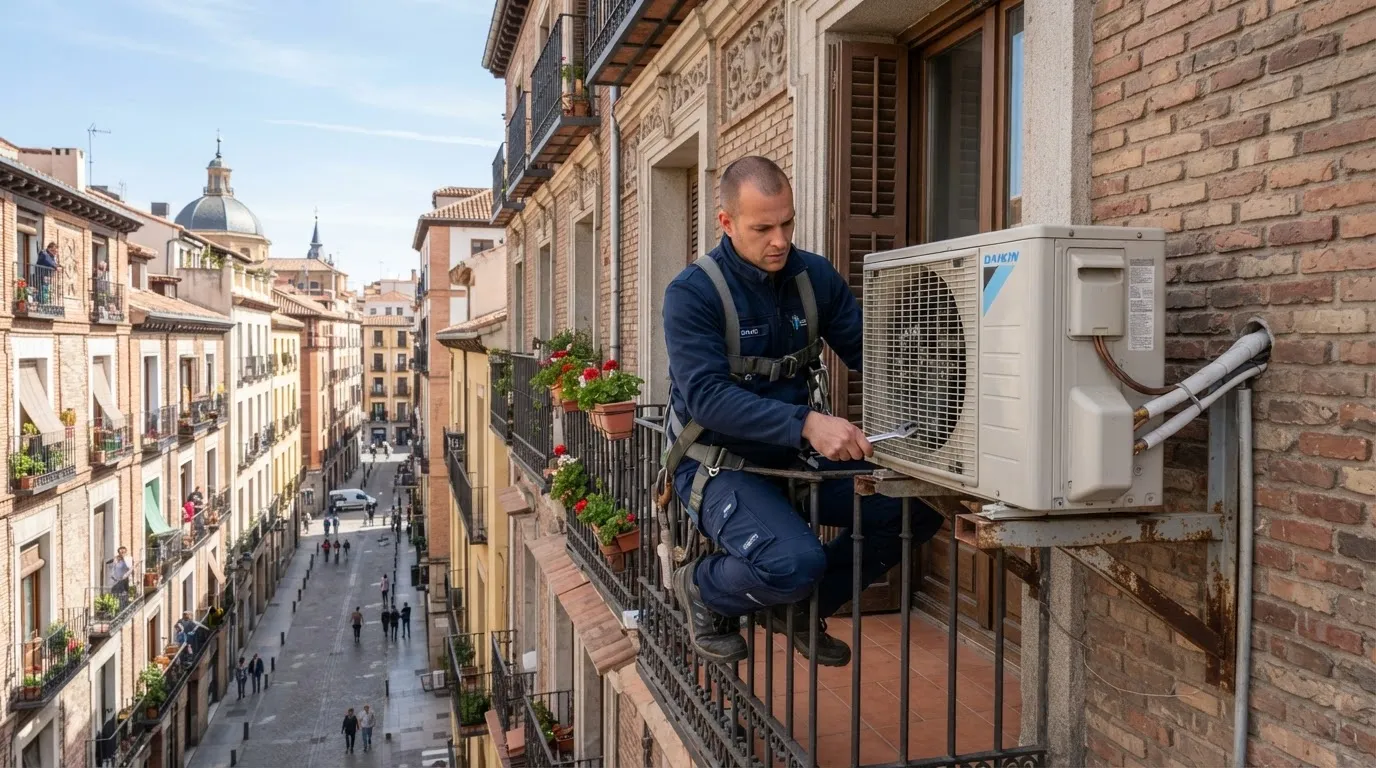
Installing an outdoor air conditioning unit in a Madrid apartment is rarely as simple as drilling a hole and hanging the condenser. In most buildings, the facade, interior courtyard, and roof are communal elements managed by the community of owners (comunidad de propietarios). This means that before installing, you need to know what permissions you need, who grants them, and what risks you take by skipping them. This guide answers the most common questions we receive from property owners in Madrid.
Is Community Permission Mandatory?
The short answer is: almost always. Under Article 7 of Spain's Horizontal Property Act (Ley de Propiedad Horizontal, LPH), installing a new element on the facade or communal elements requires the community's agreement. However, there's an important exception: when the installation is carried out on a privative element (for example, an exclusive-use terrace or a light well assigned to a specific apartment), the owner may install without a vote, provided it doesn't affect the building's aesthetics or cause nuisance to other neighbors.
In practice, most apartments in Madrid —especially in neighborhoods like Chamberí, Salamanca, or the city center— have the outdoor unit on the facade or in a communal interior courtyard, so community permission is necessary.
What Does the Law Say Exactly?
- Article 7.1 LPH: installing elements on the facade or communal elements requires agreement by simple majority (more than 50% of ownership shares).
- Article 7.3 LPH: if the installation affects the building's aesthetics, a qualified majority is required (three-fifths of owners and shares).
- Article 10 LPH: the owner may carry out works inside their apartment without permission if they don't affect communal elements or structure.
- Spanish Civil Code (art. 590): the owner may carry out works on their property, but cannot harm other co-owners.
In most cases, installing an individual split unit on the facade is processed with a simple majority agreement. If the building is listed as protected heritage, requirements are stricter and a permit from Madrid City Council may also be required.
Step-by-Step Process to Obtain Permission
| Step | Action | Estimated Time |
|---|---|---|
| 1 | Request the property manager (administrador de fincas) to include the item on the next meeting agenda | 1-2 weeks |
| 2 | Submit technical report (brand, model, location, visual impact) | 1 week |
| 3 | Vote at owners' meeting (in-person or online) | Per meeting calendar |
| 4 | Obtain certified copy of the agreement and minutes | 1-2 weeks after meeting |
| 5 | If building is protected, apply for City Council license | 1-3 months |
| 6 | Schedule installation with permission in hand | Per availability |
What Happens If I Install Without Permission?
Installing without community authorization is a real risk. The community can demand immediate removal of the unit via notarized request and, if the owner refuses, take legal action. Spanish courts have ruled in numerous judgments in favor of communities ordering the removal of outdoor units installed without permission, even when the owner had been using them for years. Additionally, if the building is protected, the City Council may impose a fine for unauthorized work.
Special Cases in Madrid
Protected Buildings (Heritage Catalogue)
Madrid City Council maintains a Catalogue of Protected Buildings. If your building is listed, any intervention on the facade requires a municipal license, not just community permission. Neighborhoods like Chamberí, Salamanca, Justicia, and the historic center have a high density of listed buildings.
Interior Courtyards (Patios de Manzana)
Interior courtyards are communal elements in most Madrid buildings. Even if the courtyard is assigned to your apartment, if the installation alters the aesthetics or generates audible noise for other neighbors, the community may object. The usual technical solution is to place the unit on a private balcony or terrace, or use brackets that minimize visual impact.
Existing Pre-installations
If your building has AC pre-installation (corrugated tubes embedded in the wall since construction), the outdoor unit goes on a technical platform designed for that purpose. In these cases, community permission is usually implicit, since the infrastructure was approved during the building's development. It's worth confirming with the property manager.
Need Help With Permission and Installation?
We prepare the technical report you need to submit to the community, advise you on the most discreet location, and carry out the installation respecting the agreement. Free estimation visit for installations.
WhatsApp: Permission adviceHow to Submit an Effective Request
To ensure the meeting approves your installation without friction, submit a clear technical report that includes:
- Brand and model of the unit, with manufacturer's technical sheet.
- Photomontage or render of the proposed location on the facade or courtyard.
- Location plan with dimensions.
- Commitment to respect the building's aesthetics (unit color, discreet brackets).
- Commitment to repair any damage to communal elements during installation.
A well-documented request reduces objections and speeds up the agreement. At AirPro Madrid, we prepare this technical documentation as part of the installation service.
Frequently Asked Questions
How long does community permission take?
It depends on the meeting calendar. If the next meeting is in 2-3 months, permission may take 1-3 months. Some communities allow written agreements without an in-person meeting, which speeds up the process to 2-4 weeks.
Can I install on my balcony without permission?
If the balcony is for private use (not a communal element), you can install without a vote, as long as the unit doesn't protrude beyond the facade line or alter the building's aesthetics. It's worth confirming with the property manager.
Can the community ban the installation entirely?
The community may object if the installation affects communal elements or aesthetics. However, it cannot absolutely prohibit the owner's right to install climate control. If the majority rejects it, the owner can take legal action, but it's a slow and costly process.
What if my building is protected?
You'll also need a license from Madrid City Council. The process is longer (1-3 months) and may require a technical project signed by an architect. We advise on the specific requirements.
Related Articles

Ducted vs Split Systems: Which is Best for Your Home in Madrid?
We provide a detailed comparison of ducted and split air conditioning systems to help you decide the best climate control option for your Madrid property.

What to Expect During a Professional AC Installation
Learn the step-by-step process of how our technicians install your new climate control system cleanly, safely, and efficiently.

Split vs Multi-Split: Which to Install in Your Madrid Home?
Discover the key differences and which is the best option for cooling your apartment, penthouse, or villa.